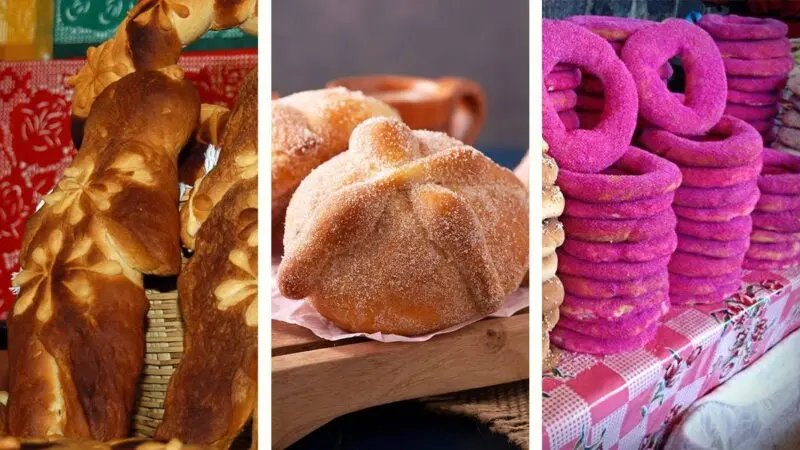
Traditional bread of the dead: We all, or almost all of us, know the traditional bread of the dead, which is in the shape of a half orange; Its base is flat and in the central part of its surface it has a ball, from which four or more “bones” are derived that descend and section the dessert into fractions. The most common flavors are varnished with butter and sprinkled with sugar; There are also varnished with egg and sprinkled with sesame seeds. Some stores sell them in flavors such as: chocolate, cream cheese, fruit jams or filled with stews.
The one from Mixquic: Mixquic is a famous town in Mexico City (CDMX) where a beautiful, emotional and great party is held in the cemeteries on the Day of the Dead. At night, the inhabitants bring food to the graves of their loved ones, and among those dishes is a dessert called “despeinadas.” These are red sugar donuts, there is also one baked in the form of embroidery with the same dough and a cross in the center. For deceased girls, one is made in the shape of a butterfly, since it was believed that, when they died, little girls became flying beings.
The deaths”: The “deaths” are saucers that are kneaded to give them a human-like shape; They are consumed in the State of Mexico and Guerrero.
Chubby: Gorditas are made of cracked corn and egg. “Bones” made of white dough and butter are placed on them, which are decorated with sugar. They are consumed in the Valley of Mexico.
“Tortillas”: rectangular It is a flattened corn dough that is baked so that the surface is whitened; Red spots are painted on it, which represent pre-Hispanic sacrifices. They are typical of Edomex.
Quesadillas: Those prepared for the Day of the Dead are in the form of empanadas filled with piloncillo and fresh cheese, and you find them in the metropolitan area of the Valley of Mexico.
Rabbit Bread: In Texcoco, Edomex, rabbit bread is made with butter, walnuts, guava and cinnamon.
Skulls: Also in Texcoco you can try the cookie dough “skulls,” which are glazed with pink sugar dots.
Shrimp: In the offerings (huentli) breads called “shrimps” are placed, which are varnished with egg and have a “U” shape. They are placed in the warrior offerings.
Souls with sugar: In Guerrero you buy this type of food that has a human shape; It has sugar and a little pink coloring is added. In this state, animal figures are also baked for deceased children.
Souls: In Guanajuato they also make bread for the Day of the Dead in the shape of a human, which is covered in sugar and colored paint is put on it if it is for an adult; If it is for a child, it is purchased completely white.
Moorish: In Hidalgo, a type of bolillo is prepared, which has sesame seeds and reliefs in the shape of colored flowers.
Bodoques: In Xochicoatlán, Hidalgo, “bodoques” are offered to people who attend a novena. These are breads in the shape of bolillos that have cross-shaped “bones” in the center, similar to those placed on traditional breads.
Wigs: At the wakes of the Huasteca region, “wigs” are distributed, which are similar to pambazos, except that they have a ball of dough at the end that resembled the chongos or molotes that were made in ancient wigs.
Threads: In Tula, Hidalgo, there is heart-shaped bread of the dead, similar to human bread. It is sprinkled with white and pink sugar.